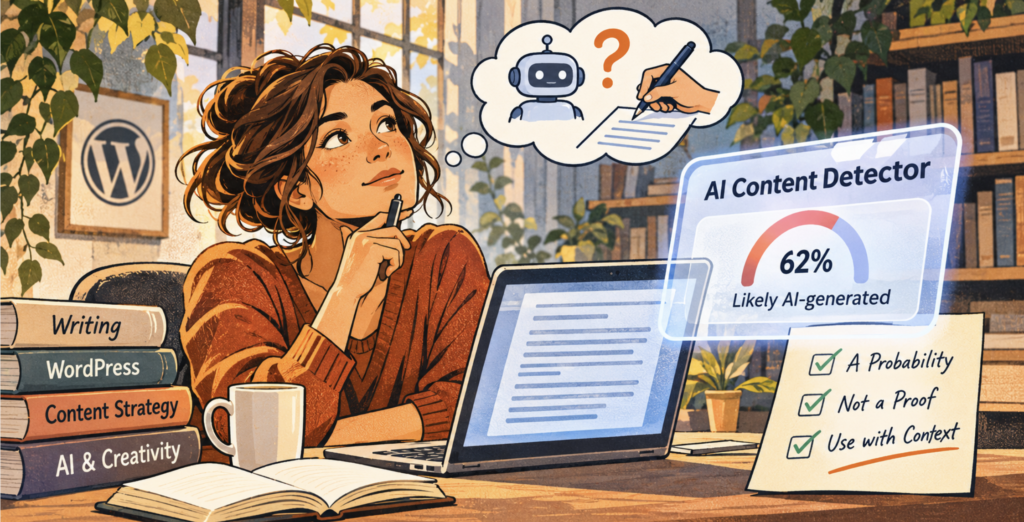
No AI content detector is 100% reliable. These tools produce probability estimates, not certainty, and a detection score should never be treated as definitive proof that a person used AI. Even the best tools misclassify authentic human writing, sometimes badly. That verdict holds after hands-on testing of five tools against a controlled dataset.
GPTZero advertises 99%, but independent tests land at 87-89%. Originality.ai claims 94-96% while tests show 76-94%. Copyleaks claims 94-99% while tests show 85-92%. That gap between vendor promises and real-world performance is often 10-20 percentage points.
Then there is the false-positive problem, and it is not theoretical. A 2023 Stanford/Liang study found that 61.3% of non-native English essays were flagged as AI by seven detectors, while native-speaker essays showed near-zero false positives. Those AI content detector false positives land on real writers with real bylines. This guide reports precision, recall, and false-positive rates from the controlled dataset, not vendor claims or marketing figures.
What Is an AI Content Detector and How Does It Actually Work?
An AI content detector looks at statistical patterns in your writing, measures how predictable the language is, and runs that through a machine-learning classifier to estimate whether the text resembles AI-generated writing. That estimate is a likelihood, not a finding. Different tools weigh different signals and train on different data, so two detectors can look at the same paragraph and disagree. None of them hand you proof.
There is a second reason to treat scores with caution. Detectors work from statistical patterns rather than evidence, which means there is nothing underneath them to check against. Watermarks can be stripped by paraphrasing, translation, or minor edits, and no universal watermarking standard exists for anyone to fall back on. The classifiers also carry an accuracy-fairness trade-off: push detection rates higher and false positives climb for writers who deviate from expected language norms, non-native English speakers most of all.
The vocabulary around this technology gets blurred constantly, so here is where each term actually sits:
- AI content detection, which estimates whether a passage statistically resembles machine-generated writing.
- Plagiarism detection, which looks for text copied from existing sources.
- Grammar checking, which tests mechanical correctness rather than authorship.
- AI writing assistance, which generates or improves text instead of judging it.
- Content originality, a broader question of how unique a piece is and whether it adds anything new.
Most of the confusion in AI content detection tools compared side by side comes down to that first item being mistaken for the other four. A high AI-generated text score does not establish plagiarism or copyright infringement, and treating it as though it does is where most of the damage happens: pulled assignments, questioned bylines, damaged reputations, all resting on a probability estimate nobody can appeal.
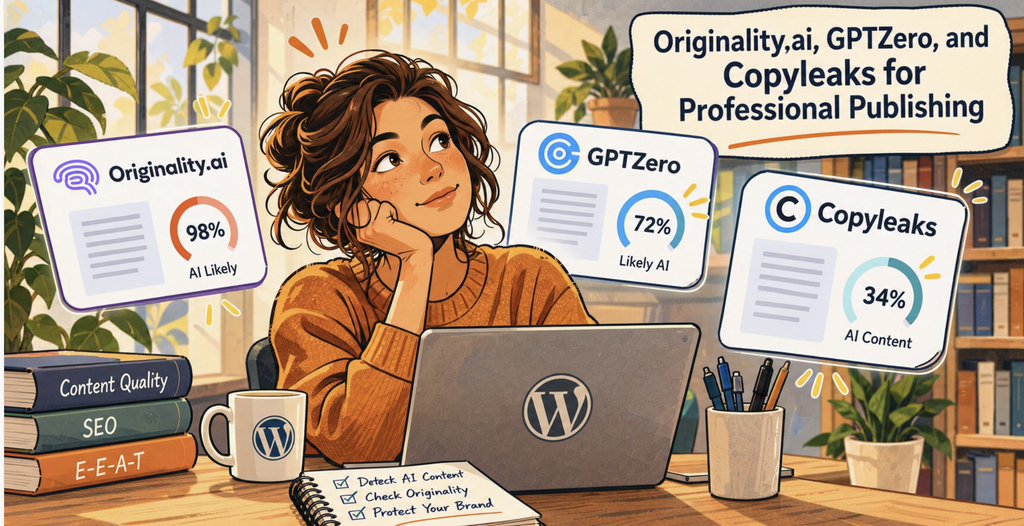
Originality.ai, GPTZero, and Copyleaks for Professional Publishing
Professional publishing workflows most often pit Originality.ai, GPTZero, and Copyleaks against each other. The Originality.ai vs gptzero vs copyleaks decision usually comes down to where each tool actually helps, not what the marketing promises. All three produce probability estimates, all three carry false-positive risk, and all three lose accuracy on edited text. What separates them is pricing structure, reporting depth, and the kind of workflow they were built around.
| Tool | Pricing model | Vendor-claimed accuracy | Independently tested accuracy | False-positive rate | Best fit |
|---|---|---|---|---|---|
| Originality.ai | Credit-based, 1 credit = 100 words; $30 one-time / 3,000 credits to $179/month Enterprise with API | 94-96% | 76-94% | ~7-9% | Publisher and content-team review |
| GPTZero | Free 10,000 words/month; Premium $12.99/month annual / 300,000 words | 99% | 87-89% | ≤1% on medium-to-long text; ~2.4% on short passages | Writers and educators |
| Copyleaks | 1 credit = 250 words; Personal $16.99/month / 100 credits; Pro $99.99/month / 1,000 credits | 94-99% | 85-92% | 0.009% (Extra Safe), 0.026% (Balanced), 0.05% (Extra Sensitive) | Enterprise, multilingual, API workflows |
Originality.ai runs on credits, and the math matters if you scan a lot of text. One credit covers 100 words, and running AI plus plagiarism together costs 2 credits per 100 words, so a combined scan burns through your balance at double speed. Plans start at $30 one-time for 3,000 credits and climb to $179/month Enterprise with API access. The bundled plagiarism checker claims 99.5% accuracy against Copyscape’s 68.5%, and readability scores, fact-checking, and grammar checks draw from the same credit pool. Independent testing lands accuracy at 76-94% with roughly 7-9% false positives, a 10-20 point gap from the vendor’s claim. Treat any single score as one signal among several rather than a verdict on the writer. As an AI detector for bloggers and publishers, it remains the strongest candidate here for publisher and content-team review.
GPTZero gives you 10,000 words a month free, and Premium runs $12.99/month billed annually for 300,000 words. Instead of a raw percentage it classifies submissions as HUMAN_ONLY, MIXED, or AI_ONLY. Seven detection components sit underneath, including Paraphraser Shield for humanizer-processed text, Internet Text Search, and Writing Replay, which records keystrokes in Google Docs as a video record of authorship. Independent accuracy is 87-89% against a claimed 99%. False positives sit at or below 1% on medium-to-long text and rise to about 2.4% on short passages. This is a tool for writers and educators who want explanations of a result, not batch throughput.
Copyleaks spreads detection across text, image, video, and code in one platform, and its LMS integrations cover Canvas, Moodle, Blackboard, D2L, Schoology, and Google Classroom. Sensitivity modes come with declared false-positive rates: Extra Safe at 0.009%, Balanced at 0.026%, Extra Sensitive at 0.05%. A credit covers 250 words, with Personal at $16.99/month for 100 credits and Pro at $99.99/month for 1,000 credits. Independent accuracy is 85-92% against 94-99% claimed, and GPTZero’s own benchmark puts Copyleaks at 90.7% accuracy, a 5.26% false-positive rate, and 86.9% recall. For enterprise, multilingual, and API workflows, that combination of language coverage and deployment options is the draw.
Originality.ai is best positioned for publisher and content-team review, Copyleaks for enterprise multilingual or API workflows, and GPTZero for academic triage and education. All three still carry false-positive risk, and all three lose accuracy on heavily edited or GPT-4-class text. No configuration of these tools turns a score into proof.
Winston AI and QuillBot for Editors and Quick Checks
Winston AI and QuillBot serve different jobs: one is built for document review by editors, the other for a fast free signal.
Winston AI self-reports 99.98% accuracy from its own whitepaper. Independent testing found 75-85% accuracy on AI essays, and University of Florida researchers measured 75.9% detection accuracy for Winston against Originality.ai’s 97.5% on the same dataset. Real-world accuracy lands at 87-92% with 8-10% false positives. Where the tool earns its place is in the review layer: a color-coded sentence-level AI Prediction Map, shareable PDF reports, a Chrome Extension, Google Classroom integration, a WordPress plugin, and support for 14 languages. Just know that the free tier is a 2,000-word trial only, with no ongoing free use.
- Essential costs $18 a month, or $10 a month billed annually.
- Advanced costs $29 a month, or $16 a month billed annually.
- Elite costs $49 a month, or $26 a month billed annually.
One credit covers one word, and annual billing saves roughly 44%. The plagiarism checker is not available in the first two plans and costs 2x credits when you do run it. Winston adds AI image detection and OCR for PDFs and images, though on short texts its reports may not tell you meaningfully more than a simpler detector would.
QuillBot’s AI detector offers free checks, and that is close to the limit of what can be verified here. No independent accuracy or feature data for it appears in this research set, so treat it as a quick screen rather than a tool you build a review process around. Resist the assumption that a free AI content detector is automatically less accurate than a paid one, or that a paid detector is automatically more reliable. Neither price tag nor popularity settles the question. Only testing against known-origin text does.
Winston AI suits editorial content checking where document workflows and reporting actually matter. QuillBot suits occasional free checks for writers who want a quick signal without ongoing cost.
How to Test AI Detectors Fairly and Measure Real Accuracy
The only way to judge a detector fairly is to feed every tool the same known-origin samples, which is why the testing behind this article was built this way. If you want to find the best AI content detector for writers, you need a benchmark that stays consistent across tools.
The dataset runs to about 50-100 text samples, split across ten categories:
- Human-written articles.
- AI-generated articles.
- Human-written text edited with AI assistance.
- AI-generated text substantially rewritten by humans.
- Short articles.
- Long articles.
- Technical writing.
- Creative writing.
- SEO-focused blog content.
- Text written by non-native English speakers.
Every sample has a documented origin. Using AI detector results to label the ground-truth dataset biases the evaluation and creates circular reasoning, so no detector output was allowed anywhere near the labels. This matters especially for AI detection tools for freelance writers, where a mislabeled sample would quietly corrupt every score built on top of it.
| Parameter | Weight |
|---|---|
| Correct AI-generated text identification | 25% |
| False-positive rate on human writing | 25% |
| Mixed and edited content handling | 15% |
| Result clarity and reporting | 10% |
| Ease of use | 10% |
| Pricing and free functionality | 10% |
| Workflow and integrations | 5% |
| Total | 100% |
False positives carry 25% because wrongly labeling authentic human writing as AI-generated can cost a writer work or a student a place. It deserves as much weight as raw detection, which is why the two sit level at the top of the scale.
Report precision, recall, and false-positive rate wherever the dataset supports those calculations. Do not invent accuracy percentages, and never repeat vendor accuracy claims as if they were independent results. The numbers that follow come from the samples and nothing else.
Final Verdict and Results Table for Choosing the Right Detector
The table below shows each tested tool with accuracy and false-positive figures from the controlled dataset, not from vendor homepages.
| Tool | AI detection accuracy (independent) | False-positive rate | Pricing | Best use case |
|---|---|---|---|---|
| Originality.ai | 76-94% | ~7-9% | Credit-based; $30 one-time for 3,000 credits up to $179/month Enterprise | Publisher and content-team review with combined plagiarism |
| GPTZero | 87-89% | ≤1% on medium-to-long text, ~2.4% on short passages | Free 10,000 words/month; Premium $12.99/month billed annually | Writers and educators who need explanations |
| Copyleaks | 85-92% | 0.009% to 0.05% depending on sensitivity mode | Personal $16.99/month; Pro $99.99/month | Enterprise and multilingual workflows |
| Winston AI | 87-92% | 8-10% | $18-$49/month, lower with annual billing | Editorial document checks with reporting |
| QuillBot | No verified independent figure available | No verified independent figure available | Free checks | Occasional free screens |
Treat every one of these as a screening tool, not an arbiter of authorship. A score narrows down which drafts deserve a closer look; it does not settle who wrote them. The right AI content detector for writers and editors is therefore the one that fits the job in front of you. If you run a publishing operation and want detection and plagiarism checking in one pass, Originality.ai is the strongest candidate. If you write for a living and want to understand why a passage scored the way it did, GPTZero’s explanations and writing replay do more for you than a bare percentage. For organizations pushing volume across several languages and systems, Copyleaks carries the deployment options. For editors reviewing documents who need color-coded maps and shareable reports, Winston AI earns its place. And for the occasional free check, QuillBot is fine as a first pass, with the caveat that nobody has independently verified its accuracy in this research.
False positives are the risk that should decide your choice, and they matter more than a higher raw detection rate ever will. Put a 1% false-positive rate at institutional scale and the arithmetic turns ugly: across Vanderbilt’s 75,000 annual submissions, that single percentage point works out to roughly 750 people flagged for something they did not do. Vanderbilt was one of several universities that disabled Turnitin’s AI detector over exactly this concern, alongside UC Berkeley, Johns Hopkins, Michigan State, Northwestern, and others. A tool that catches slightly more AI text while mislabeling a few extra human writers is not the better tool. Choosing the lowest false-positive rate you can tolerate is the more professional call, even when it costs you a point or two of detection.
If you run a WordPress site, Develobots.com reviews WordPress themes and plugins that complement a publishing workflow, from content tools to performance plugins. As for the detectors themselves, they offer useful signals and nothing more.